
A Software Bill Is Not a Security Plan: Turning SBOMs into Continuous Supply-Chain Protection
How to turn software component transparency into a repeatable vulnerability-management capability
In this article
SBOM security starts with a software bill of materials (SBOM), often described as an ingredients label for software. It lists components used to build or deliver an application, including direct and sometimes indirect dependencies. That visibility matters: when a vulnerability is disclosed, an organisation can search its software inventory for affected components instead of relying on guesswork. But an ingredients label does not tell a kitchen how to prevent contamination, inspect a supplier, or respond when a problem is found. SBOM security requires the same operational discipline.
The need to make SBOMs operational is becoming more pressing. On 29 July 2026, CISA and international partners released updated minimum elements for SBOMs, adding or refining fields such as component hashes, license information, SBOM tool details, and the context in which the SBOM was generated. The guidance also stresses machine-processable formats and addresses software types including AI and SaaS [1]. The important message for technology leaders is not simply to collect more files.
What SBOM security data can tell you—and what it cannot
SBOM security data can describe component names, versions, suppliers, identifiers, dependency relationships, and other facts about the software being examined. Depending on the format and generation method, it may cover open-source packages, commercial components, operating-system libraries, build tools, containers, or selected AI-related components. That makes it useful for procurement reviews, incident response, license reviews, and understanding where an organisation depends on a particular maintainer or supplier.
SBOM security data does not prove that software is secure. It may be incomplete, generated at the wrong lifecycle stage, or out of date after a new build. It does not, by itself, establish whether a vulnerability is reachable in the deployed configuration, whether a vulnerable function is used, whether compensating controls exist, or whether an exploit is active. It also cannot replace secure coding, code review, penetration testing, access control, patch management, or operational monitoring.
Start with a reliable inventory, not a file-collection target
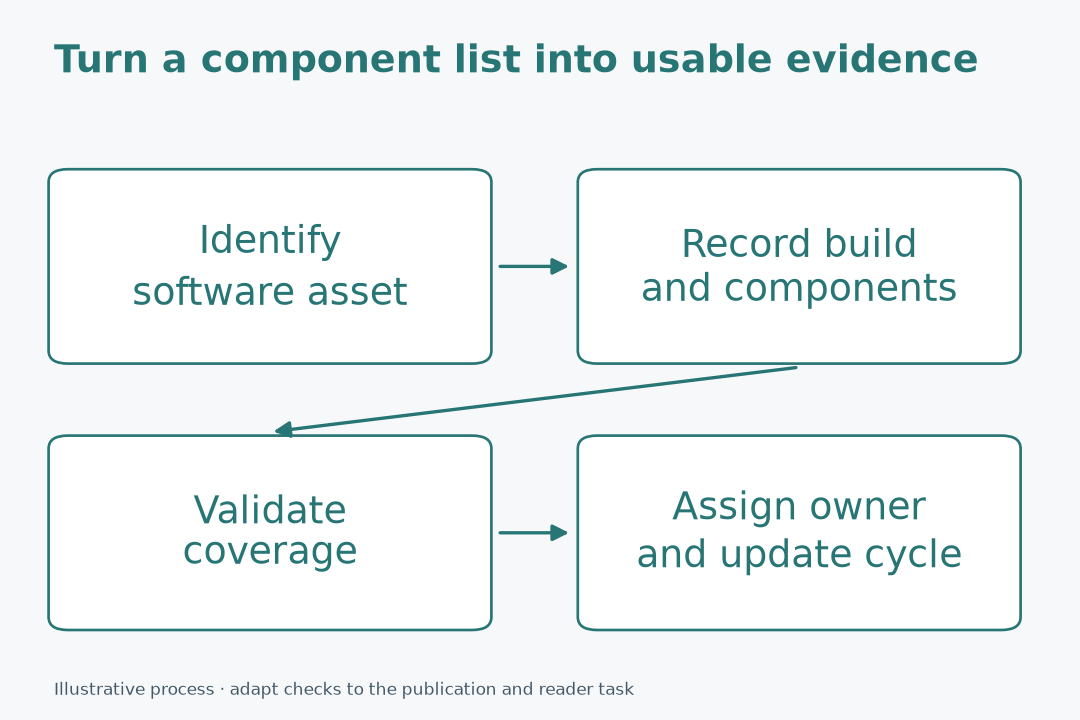
The first practical step is to decide which software assets need coverage. Include internally developed applications, purchased products, cloud services, container images, embedded software, and critical supplier integrations. Give each asset an owner, business criticality, deployment environment, and lifecycle state. Without this context, a security team may discover a vulnerable library but be unable to answer a basic question: which business service is using it, and who can approve a fix?
Next, define how SBOMs will be created and updated. An SBOM generated from source code before a build may differ from one generated by inspecting the final binary or container. The 2026 minimum-elements guidance explicitly introduces generation context so consumers can understand what the SBOM represents [2]. For high-risk products, generate or verify SBOM data at more than one stage: during development, after release packaging, and when material changes occur.
Make the data usable by security teams
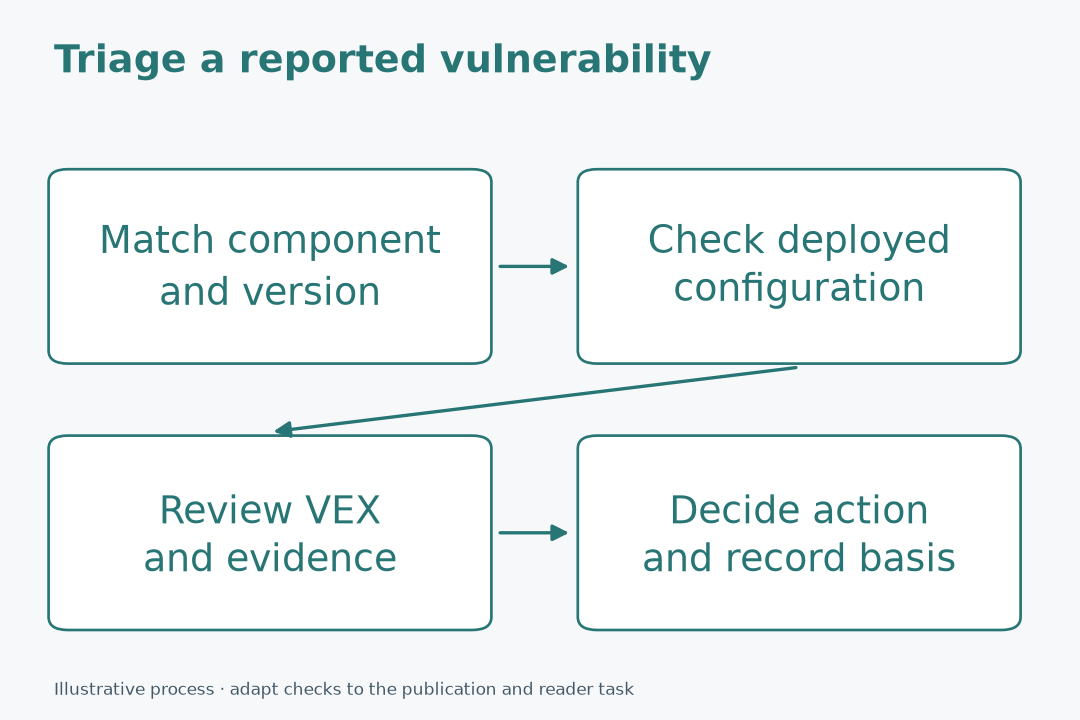
A machine-readable SBOM should feed a searchable inventory or software-composition analysis process. Map component identifiers to vulnerability databases and supplier advisories. Use consistent identifiers, such as Package URLs or other recognised component identifiers, so that a package is not missed because one system calls it by a product nickname while another uses a registry coordinate. Preserve dependency relationships: a component hidden several layers below an application can be just as important as a direct dependency.
The next step is triage. Do not send every match into an identical emergency queue. Assess whether the affected version is actually present, whether the vulnerable code path is reachable, whether the component is exposed, whether a fix exists, and how important the affected service is. The CISA Vulnerability Exploitability eXchange (VEX) model can add machine-readable context about whether a product is affected by a vulnerability [3].
Connect findings to ownership and remediation
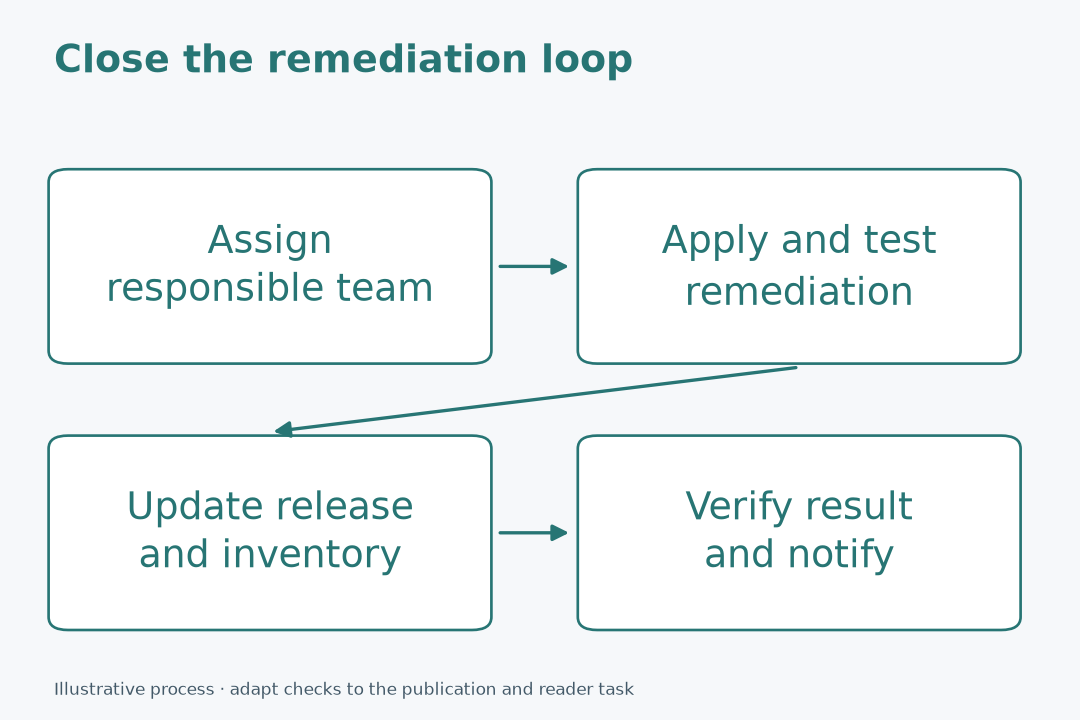
A useful workflow turns a match into a managed issue. The security team should identify the application owner, open a ticket with the affected component and evidence, set a risk-based due date, and track the decision. The engineering team may upgrade a dependency, rebuild a container, apply a mitigation, disable a vulnerable feature, or document why the issue is not exploitable in the deployed configuration. Any exception should have an approver, rationale, expiry date, and review trigger.
Integrate the process with existing vulnerability management and asset-management tools rather than creating an isolated SBOM dashboard. Joint CISA and international guidance makes this point directly: SBOM data has to be consumed and mapped to vulnerability databases, security advisories, supply-chain information, and end-of-support data to produce useful insight [4]. A vulnerability record should remain linked to the component, product version, environment, and remediation evidence so that the organisation can answer auditors and incident responders later.
Build supply-chain expectations into procurement
For SBOM security, buyers should ask suppliers for more than a promise to “provide an SBOM.” Contracts and security schedules can specify the delivery format, scope, update frequency, versioning, authenticity controls, and a process for notifying customers when a material vulnerability is discovered. Ask whether the SBOM covers runtime components, build dependencies, AI model packages, SaaS elements, and third-party services, and ask suppliers to disclose known limitations.
For cloud services, the provider may not be able to disclose every internal implementation detail. That does not make transparency impossible. The supplier can provide scoped component information, attestations, vulnerability-management summaries, or a customer-facing notice process. The objective is not to obtain every source file. It is to establish enough dependable evidence for the buyer to understand exposure and act quickly.
Measure whether the SBOM security programme is improving outcomes
An SBOM security programme should measure outcomes, not simply count SBOMs. Track the percentage of critical applications with current, validated SBOMs; the time between a component advisory and an internal impact assessment; the time to identify the owner of an affected service; the percentage of high-risk findings with a documented disposition; and the age of unresolved exceptions.
Use these measures to improve the process, not to punish teams for every late patch. Some components cannot be upgraded immediately because of compatibility, certification, or vendor constraints. Good governance makes those constraints visible and ensures that compensating controls and review dates exist. The strongest programme joins transparency with engineering capacity, clear accountability, and executive support.
Illustrative scenario: a vulnerable library in a customer portal
A retailer learns that a widely used logging library has a serious vulnerability. Its security team searches a central SBOM inventory and finds the library in three products: a public customer portal, an internal analytics tool, and a test container that is not deployed. The SBOM records the component versions and hashes, while the asset inventory identifies service owners and internet exposure.
The portal team upgrades the dependency, rebuilds the image, produces a new SBOM, and verifies the component hash and deployed version. Security closes the finding only after evidence is attached. The value came not from possessing three SBOM files, but from knowing where the affected package existed, who owned it, and whether the fix reached production.
Conclusion
An SBOM is a foundation for software transparency, but it becomes a security capability only when it is accurate, current, searchable, and connected to vulnerability intelligence and remediation workflows. Start with critical assets, standardise generation and supplier expectations, add exploitability context, and measure how quickly the organisation can move from disclosure to informed action. The goal is not a larger library of software lists.
Frequently Asked Questions
Is an SBOM the same as a vulnerability scan?
No. An SBOM lists software components and relationships. A vulnerability scanner compares detected components or code with vulnerability information. The two are complementary: the SBOM provides inventory context, while scanning and advisory correlation help identify potential exposure.
How often should an SBOM be updated?
Update it whenever the software composition changes and establish a cadence for products whose dependencies or deployment environment change frequently. For important releases, generate a new SBOM as part of the build or release process rather than relying on an old attachment.
Does an SBOM guarantee that software is secure?
No. It improves transparency but does not prove that components are free of vulnerabilities, that the software was securely developed, or that operational controls are effective.
What is the difference between SBOM and VEX?
An SBOM describes components in a product. VEX communicates a product’s status in relation to a particular vulnerability, such as whether the product is affected or not affected and why. VEX can help prioritise SBOM findings.
Should organisations request SBOMs from SaaS providers?
Yes, where feasible and proportionate. The information may be scoped or provided through an agreed transparency process, but buyers should ask how the provider tracks components, assesses vulnerabilities, and notifies customers of material risks.
Which teams should own an SBOM programme?
It should be shared. Product engineering or suppliers generate component data; security teams analyse exposure; procurement sets supplier expectations; asset owners remediate; and governance leaders establish policy, exceptions, and reporting.
Sources and Further Reading
1. NSA and CISA, Updated Software Bill of Materials guidance, 29 July 2026
2. Australian Cyber Security Centre, 2026 Minimum Elements for a Software Bill of Materials
3. CISA, Minimum Requirements for Vulnerability Exploitability eXchange, 2023
5. NIST, SP 800-218 Secure Software Development Framework Version 1.1