
Preventing Link Rot in Digital Publishing: Using Persistent Identifiers, Automated Link Checks and Digital Archiving
Prevent link rot with persistent identifiers, automated broken link checks and digital archiving. Build a reliable review and recovery workflow for publishers.
In this article
How link rot weakens published content
An editor publishes a carefully sourced investigation with links to policy documents, reference data and expert reports. The article performs well and remains online. Two years later, a government department restructures its website, a report is replaced and an external source returns an error. The publication still looks complete, but readers cannot verify several of its claims. This is link rot: the loss of access to resources at their original addresses. When a page remains reachable but its meaning changes, the problem is often called content drift.
Digital publishers have good reasons to treat link rot and content drift as production-quality problems rather than occasional housekeeping. An August 2026 study of web citations in library and information science literature examined 2,886 citations from 608 articles across four journals, reflecting continued research attention to citation decay and recovery. Broken references undermine trust, discovery, reuse and the long-term value of a content archive. They also create a technical challenge that publishers can address systematically.
A URL, an identifier and an archived copy do different jobs
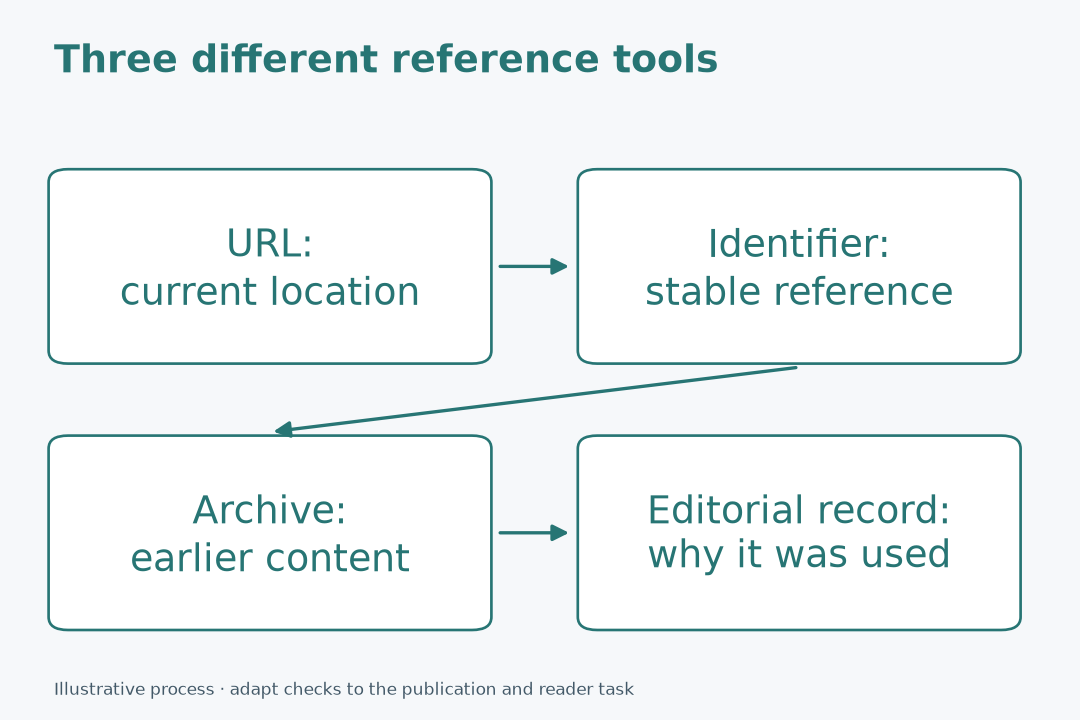
A normal URL describes where a resource can currently be reached. It is convenient, but ownership changes, migrations and deleted content can make it fragile. A persistent identifier, such as a Digital Object Identifier (DOI), gives a work a stable reference that can be resolved to its current location. An archive preserves a copy or record of content, depending on the archiving service and its rules.
These functions complement each other. Crossref recommends displaying DOIs as complete `https://doi.org/…` links and updating registration metadata when a content location changes. Crossref also emphasizes that persistent linking still requires ongoing stewardship; there is no purely technical fix if responsible organizations stop maintaining their records.
An archived citation addresses a different question: what did this source say when the article relied on it? Perma.cc, developed by Harvard Law School Library with supporting libraries, creates preserved records of cited web pages. It is particularly useful where readers need to compare current information with an earlier state. A DOI may help locate a work today, whereas a timestamped archival record helps establish what was previously available.
Start with a link inventory, not a website-wide scan
Publishers often maintain content in a content management system, digital asset manager and exported formats such as HTML, EPUB or PDF. Links may appear in the article body, footnotes, figure captions, reference lists, embedded media and supplementary files. An effective link rot prevention program starts by finding these links and understanding their purpose.
Export the content inventory with publication identifier, page URL, outbound destination, link text, link type and last checked date. Classify internal links, external citations, DOI links, downloadable files and temporary references such as event registration pages. This classification determines what a link rot failure means. A dead purchase link needs a commercial update; an inaccessible evidence source requires editorial attention; an outdated internal route may be fixed with a redirect.
For link rot prevention, prioritize high-value content, often-cited pages and resources that support factual claims. A million low-risk navigation links should not obscure ten broken references in a regulatory guide. A manageable first phase is to inspect newly published content automatically and backfill an important archive section by section.
Design a checker that understands more than status codes
A scheduled link rot checker can request destinations, follow redirects within safe limits, and record response status, redirect chain, final URL, content type and response time. But HTTP success does not prove editorial success. A page may return `200 OK` while displaying a login wall, an unrelated homepage, a bot challenge or ‘document removed’ text.
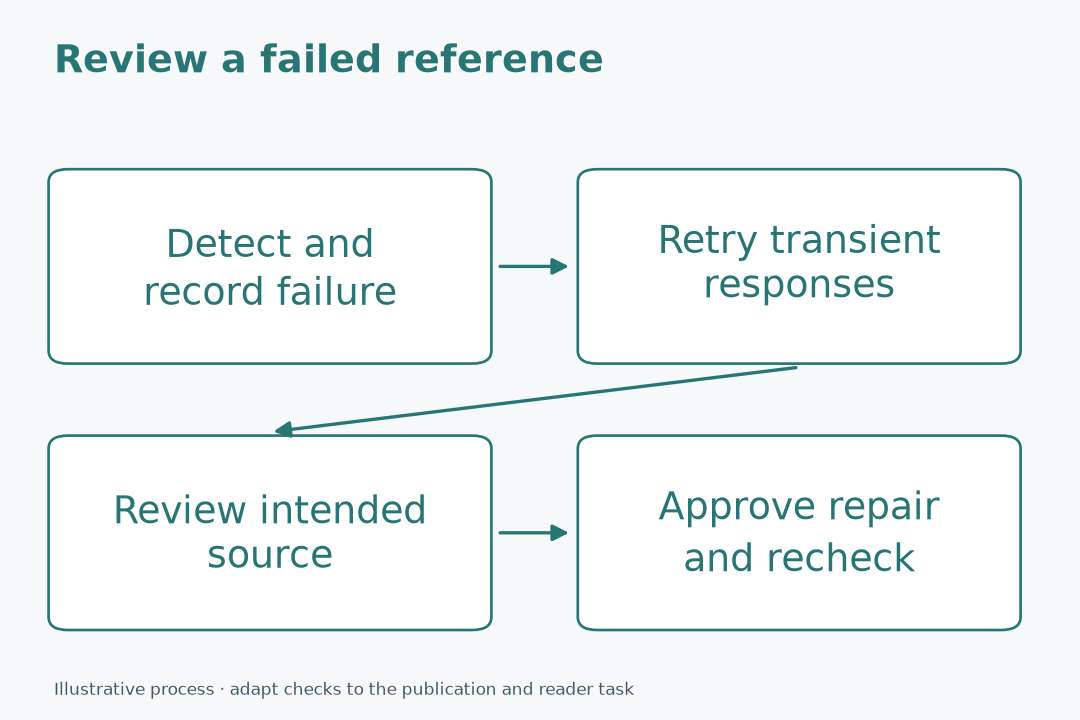
Build a review queue rather than automatically replacing every failed URL. Different failures call for different actions. A persistent `404` may indicate deletion; a `429` may reflect rate limiting; a `403` may be a permissions or anti-bot issue; and a timeout may be temporary. Respect site policies, use backoff, set reasonable concurrency, and do not treat temporary access restrictions as proof that content has disappeared.
For high-value references, compare page titles, expected document identifiers or checksums where appropriate. Flag substantial changes for human review. Keep a snapshot of the previous check so teams can distinguish a newly broken link from a long-standing issue. Log each result with a timestamp and checker version; otherwise, audits become difficult to reproduce.
Build preservation into the editorial process
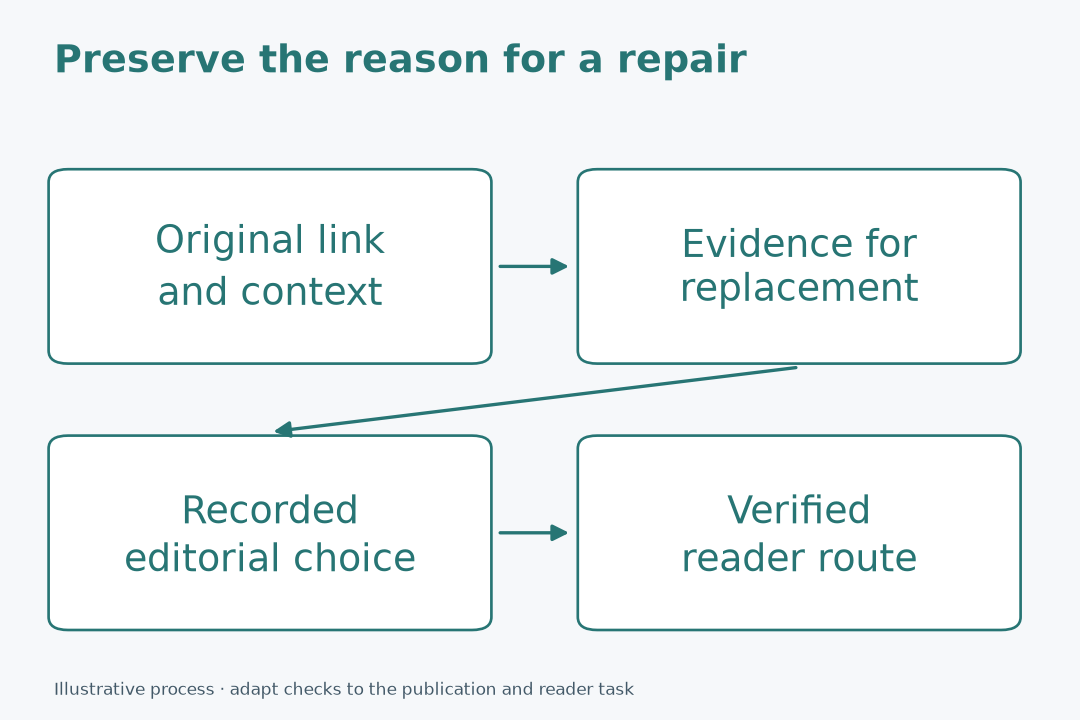
Pre-publication checks for link rot should confirm that cited URLs resolve, metadata is correct and link text meaningfully describes the destination. When a source is likely to change, editors can consider an approved archival service and record both the original URL and its preserved reference. Archiving should follow copyright, privacy, terms of use and the preservation service’s restrictions; it is not a blanket authorization to copy paywalled or confidential material.
After publication, automate periodic checks for high-value content, perhaps more frequently during the first month and less frequently for stable historical material. When a problem is found, keep the original editorial record intact while adding a correction, replacement citation or explanatory note as required by house policy. Silent changes to evidence can make an archive difficult to trust.
Crossref and services such as Portico address additional layers of the preservation problem. DOI registration supports stable identification and linking, while preservation services safeguard deposited scholarly content against long-term access failures. Neither replaces editorial judgment about external sources or a publisher’s responsibility to maintain its own site.
A practical publishing architecture
Imagine a publisher with 80,000 digital articles. The CMS emits an event each time an article is published or updated. A link-extraction service reads the article’s structured content and creates normalized link records. A queue sends eligible URLs to a rate-limited checker. Results are stored centrally and surfaced in an editorial dashboard showing article owner, severity, last known result and suggested next step.
When an editor chooses a correction, the workflow records the decision, updates the CMS and triggers a new check. Redirect-management APIs handle moved internal pages; DOI metadata updates address moved registered works. Important external citations can include archived references where appropriate. An audit trail preserves the original destination and the reason for changing it.
This can be implemented incrementally with common APIs, a relational database, scheduled jobs and dashboards. For link rot prevention, the technology is less important than linking each alert to an accountable content owner. Without ownership, even accurate automated alerts become a growing inbox that nobody resolves.
Measure resilience instead of counting requests
Useful measures include the percentage of newly published articles passing link checks, unresolved high-priority references, median time to repair, percent of DOI resolutions reaching the intended article, and coverage of archival references for high-value citations. Separate internal and external links so teams are not blamed for resources they cannot control.
Track false positives too. A checker that repeatedly flags legitimate access-controlled pages wastes editorial effort and risks being ignored. Report successful fixes and prevented incidents, not merely how many URLs the system scanned. Sample previously passed links manually to verify that the checker catches content drift as well as transport failures.
Where publishers should begin
Select one content collection, identify its critical citations, configure scheduled checks and establish a clear repair policy. Add an archival-reference rule for volatile public sources and a DOI maintenance rule for registered content. Review results with editors and developers together, then expand only after the process reliably leads to corrections.
The strongest solution combines people, stable identifiers and preservation technology. Automated checking detects problems, but a publisher decides how to preserve the meaning and evidentiary value of a reference.
The takeaway
A digitally published article should remain understandable and verifiable long after its release date. URLs make content accessible now; persistent identifiers help readers locate it after moves; archived records preserve evidence of what was available at a particular time. Publishers that connect these tools to their content workflow can reduce link rot without turning every editorial update into a large technical project. Long-term trust depends on maintaining the relationships between a claim, its source and the reader who follows it.
Related reading: see how a reliable software inventory supports SBOM security and supply-chain protection.
Sources and further reading
- Crossref, Constructing your DOIs
- Crossref, Display guidelines
- Harvard Library, Perma.cc
- Perma.cc, User guide
- Portico, Digital preservation for journals, books and collections
- Link rot in LIS literature: a 20-year study of web citation decay, recovery and preservation challenges, Aslib Journal of Information Management (14 August 2026)