
The Invisible Engine of Publishing: 7 Ways Journal Workflows Strengthen Editorial Practice
Improve journal workflows with seven practical steps for manuscript tracking, peer review coordination, clear author updates and accountable automation.

In this article
Journal workflows organise the work between a submitted manuscript and a dependable publication record. They connect authors, reviewers, editors and production staff through tasks that need clear ownership. When those connections are weak, a manuscript can wait unnoticed even when every person involved is working hard.
An intelligent workflow makes the next action visible and helps people carry it out consistently. It may use automation, but its value comes from a well-defined process. These seven steps show how publishing teams can improve coordination while retaining human responsibility for editorial judgement. The examples are illustrative and do not promise a particular reduction in turnaround time.
In this article
1. Map journal workflows before selecting features
Begin with a real manuscript journey. Record what happens during initial checks, editor assignment, review, revisions, decisions, copyediting and publication preparation. Include returns, exceptions and appeals. A diagram showing only the successful route misses much of the work that makes an editorial office difficult to manage.
For each stage, specify the responsible role, required information, completion condition and next destination. “Under review” is not sufficient operational detail if nobody can tell whether invitations are pending or reports have arrived. Keep internal task states precise while giving authors a simpler, accurate explanation of progress.
PKP’s editorial workflow guide describes submission, review, copyediting and production in Open Journal Systems, with publication and post-publication activities also covered. This is one platform’s structure, not a universal journal policy. Use it as a reference when checking whether your own stages and responsibilities are complete.
Journal workflows should also accommodate absence. Name a backup editor and define how a manuscript is reassigned when a colleague is unavailable. A task assigned to a person who has left the team needs a reviewable handover, not an automated reminder sent indefinitely to an unused account.
2. Make submission checks clear and proportionate
Authors need understandable instructions and a straightforward way to provide required information. Check files, contributor details, declarations and supporting material against the journal’s published requirements. Distinguish a missing administrative item from a question about the research. A formatting issue should not silently become an allegation about scientific quality.
Journal management systems can help identify incomplete fields, missing files or inconsistent identifiers. The system should explain what is missing, preserve entered information and allow a controlled correction. Avoid requesting the same information in several places unless there is a clear reason and a reliable way to keep it consistent.
Build exception handling into journal workflows. A submission involving restricted data, an unusual article type or a complex authorship question may need a specialist route. Record who reviewed the exception and why it was accepted, returned or escalated. Administrative automation should prepare information for an editor rather than making an unsupported integrity judgement.
3. Coordinate peer review with realistic expectations
Peer review coordination involves expertise, availability, conflicts of interest and the journal’s review model. A directory of names is not enough. Keep reviewer information current, explain the request clearly and give reviewers the information needed to decide whether they can accept. Avoid repeatedly inviting the same small group simply because they respond quickly.
Use separate dates for invitation responses and completed reviews. Make reminders respectful and useful, with a clear way to decline or request an extension. Editors should be able to see which manuscripts need attention and why. A reminder is not a substitute for deciding what to do when a reviewer cannot complete the work.
PKP’s review-stage documentation explains reviewer assignments, revision requests and editorial decisions within OJS. It also makes clear that editors remain responsible for the anonymity required by their review process. File preparation and access settings need deliberate checks; choosing a review model does not remove that responsibility.
Review journal workflows for workload concentration. Track the number of invitations and active assignments per reviewer where appropriate, then interpret those records with care. Different manuscript types require different effort. A count alone should not determine a reviewer’s quality or willingness to contribute.
4. Preserve decisions, versions and communication
A dependable editorial workflow keeps the decision record understandable. Retain the version assessed in each round, the reports considered, the editor’s decision and the author’s response. Clearly distinguish a working file from an approved production file. Informal email attachments should not become the only record of an important change.
Manuscript tracking should answer practical questions: which version is current, who can see it, what is waiting and what happens next? Access should follow the role and assignment. An author should not gain access to confidential reviewer discussion, and a production contractor may not need the full peer-review history.
The COPE Core Practices address transparent peer-review processes, conflicts, complaints and post-publication correction mechanisms. Journal workflows can support these policies through clear records and escalation routes. A software platform cannot decide the appropriate policy for a journal or guarantee that every case has been handled fairly.
For long-term continuity, keep identifiers and important links consistent across handoffs. Our article on preventing link rot in digital publishing examines how persistent identifiers and link checks support durable access. Check the record itself when connecting a manuscript, dataset or final article rather than assuming that similar filenames refer to the same object.
5. Automate reminders and checks with boundaries
Useful automation handles a task whose rules can be explained. It can notify an editor that a submission is complete, flag an approaching deadline or assemble an overdue-task list. Define the event that triggers the action, the intended recipient and the condition that stops it. Include a way to pause the automation during an exception.
Test journal workflows with realistic cases before changing a live process. Try an author withdrawal, a declined invitation, an extension, a replacement editor and a manuscript returned to an earlier stage. Check whether messages remain accurate. Repeated or contradictory notifications can undermine confidence even when the underlying record is correct.
AI-assisted features need additional review. A suggested reviewer, extracted declaration or generated summary may be incomplete or wrong. Check evidence before acting, follow confidentiality requirements and avoid uploading unpublished manuscripts to unapproved services. Keep consequential decisions with authorised people and record the basis for the action.
6. Give authors clear updates and usable revision tasks
An author-facing status should explain the current stage without exposing confidential information or promising a decision date the journal cannot support. Provide a clear contact route and explain what the author needs to do. If no action is required, say so. Silence and vague labels create avoidable support requests.
Revision instructions should separate mandatory changes from optional suggestions and explain the submission requirements. Ask for a response that connects each point to the relevant change or reasoned explanation. Preserve previous versions so an editor can compare the response with the manuscript that was actually reviewed.
Accessible journal workflows also matter. Authors and reviewers may use a keyboard, screen reader or magnification. Forms, file controls and instructions should be understandable and operable. When a third-party component creates a barrier, offer a practical support route while the underlying problem is investigated.
7. Improve journal workflows using evidence
Operational measures should identify problems that a team can address. Review time spent at each stage, overdue tasks, invitation acceptance and the distribution of editorial assignments. Separate initial editorial decisions from decisions after external review. Otherwise a change in submission mix can look like a process improvement when it is not.
Use medians and the spread of waiting times where helpful, and examine individual exceptions. A single average can hide a small group of manuscripts waiting much longer than the rest. Document how a measure is calculated, which cases it excludes and what the team will do when it shows a problem.
Begin with one improvement. For example, if manuscripts wait after reports arrive, establish a visible “ready for decision” queue and a backup responsibility. Compare the result with the earlier process, ask editors whether the queue is usable and check for unintended effects. This is a proposed experiment, not a claim of proven performance.
Before expanding a change, confirm that journal workflows still preserve confidentiality, decision authority and the historical record. Faster handling is useful only when it supports dependable assessment. Update written procedures and training alongside the configuration so new staff understand both the steps and their purpose.
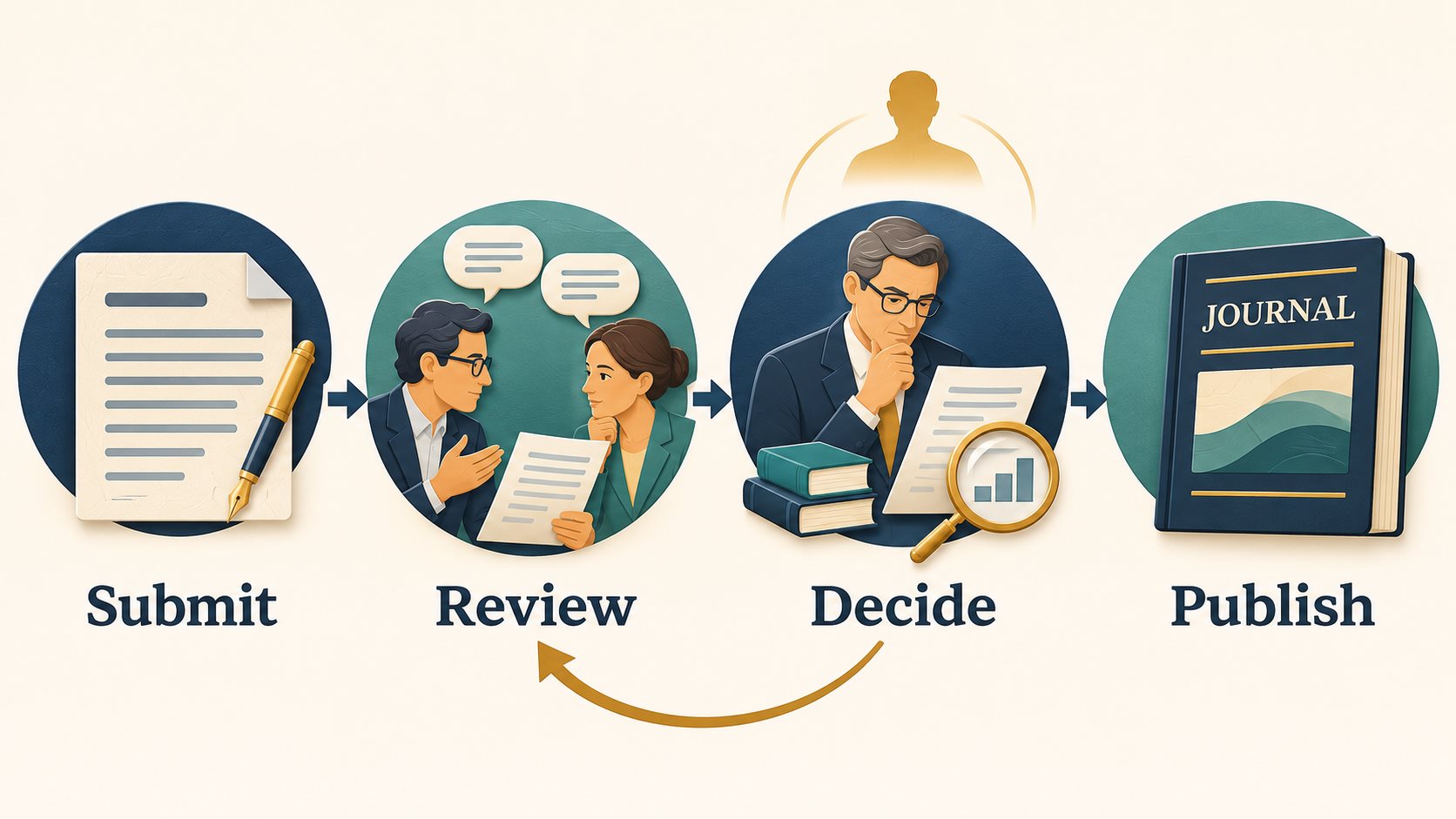
Worked example: a manuscript waiting after review
Consider a hypothetical journal where manuscripts sometimes wait after the last report arrives. The managing editor initially suspects slow reviewers, but a stage-by-stage review reveals a different problem: nobody has clear responsibility for notifying the handling editor that a decision is ready. Journal workflows should expose that handoff before the team changes its reviewer policy.
The proposed improvement creates a “ready for editorial assessment” task with a named owner and a visible date. It does not generate an acceptance or rejection. The editor reviews the manuscript, reports, declarations and any relevant concern, then records the decision through the authorised process. A backup editor can see that the task exists if the assigned colleague is unavailable.
The team tests journal workflows using a completed report, a withdrawn report and an additional report received after an editor has begun assessment. These cases check that notifications describe the record accurately. A message saying “all reviews complete” should not remain current when an editor has opened another review round or removed an unusable report.
An author update explains that the manuscript is awaiting editorial assessment. It avoids implying that favourable reviews guarantee acceptance. The editorial office also explains how authors can enquire about a prolonged wait. Clear communication reduces ambiguity without exposing reviewer identities or private discussion.
After a trial, the team compares waiting times and asks editors whether the new task helps them work. It checks for duplicate messages, overlooked reassignments and a shift of administrative burden onto another role. These findings determine whether the change should continue. This example is a process proposal, not a claim that a particular configuration has demonstrated a measured benefit.
Test journal workflows against exceptions
A reviewer declines after an invitation reminder. Confirm that reminders stop, the invitation status is accurate and an editor can choose the next action. Journal workflows should not continue contacting someone who has already declined. Check whether a late response can still be recorded without reopening an invitation unintentionally.
An author uploads the wrong revision. The record should distinguish the new file from earlier versions and provide a controlled way to correct the submission. Staff must be able to identify which file was assessed. Preserve the audit trail rather than silently replacing a file in a way that obscures what happened.
An editor reports a competing interest. Journal workflows need a route for reassignment under the journal’s policy. Check that the replacement editor can obtain the appropriate record and that access for the previous editor is handled correctly. Automated routing should not override a conflict decision merely because a subject keyword matches an editor’s expertise.
A manuscript is withdrawn during review. Verify how the team records the request, who authorises the status change and which participants are notified. Stop inappropriate reminders and preserve the necessary historical record. Withdrawal should not accidentally leave an active task asking a reviewer to assess a manuscript no longer under consideration.
An accepted article needs a substantive correction before release. Confirm that journal workflows can return the work for appropriate editorial assessment. A production deadline should not force a questionable change directly into publication. Record the decision, the corrected version and any additional review needed under the journal’s policy.
A reader raises a concern after publication. Ensure the enquiry reaches a responsible person, is acknowledged through a documented process and connects to the correct article. Post-publication cases need their own handling and records. A manuscript marked “published” should not disappear from the journal’s ability to investigate and maintain its record.
Assign ownership of configuration and access
Journal workflows evolve as policies, staff and suppliers change. Designate who can alter stages, message templates, forms and permissions. Test changes before release and record what changed, why and when. An apparently small template edit can change the meaning of every future message sent at that stage.
Review accounts when people join, change responsibilities or leave. A former editor may retain legitimate responsibilities for particular cases, but those permissions should be intentional. Service accounts and integrations also need owners. Keep access decisions reviewable without exposing confidential manuscript information to people who do not need it.
Document the configuration in language the editorial office understands. Explain the purpose of each task, the condition for completion and the route for exceptions. Journal workflows become fragile when only a technical administrator understands why a rule exists. Training should include practical scenarios, not just a tour of the dashboard.
Keep operational reporting fair and useful
Before comparing editors or journals, check that the underlying cases are comparable. Article type, subject, revision complexity and available reviewers can affect handling time. Journal workflows should help identify where support is needed rather than turn a timing measure into an unsupported judgement about a person’s performance.
A useful monthly review can examine the oldest active tasks, repeated exceptions, unassigned work and communication failures. Select a small number of cases and trace their history. The purpose is to understand the cause and agree an action, such as clearer guidance, a backup assignment or a configuration correction.
Record the action and revisit it. If a reminder schedule produces more messages without reducing unexplained waiting, reconsider the process. If a form collects information that nobody uses, review whether it is necessary. Removing unnecessary administrative work can make journal workflows easier for authors and staff while retaining the checks the journal actually needs.
Finally, make the reporting definitions visible to the people being asked to act. Distinguish elapsed days from working days, paused cases from active cases and administrative returns from editorial decisions. A transparent definition allows the team to interpret the evidence and challenge a misleading conclusion before it becomes a policy change.
Common questions about journal management systems
Can automation make editorial decisions? Routine checks can organise evidence, but acceptance, rejection and integrity concerns require the journal’s authorised editorial process. Do not treat an automated flag as proof.
Which workflow metric should a team start with? Start with the stage causing a documented problem, such as submissions waiting for assignment. Define the measure carefully and review it alongside quality and workload.
Must a journal replace its platform to improve coordination? Often the first improvement is clearer ownership, instructions or configuration. Establish the problem before deciding that new software is necessary.
The takeaway
Journal workflows work best when people can see the next task, understand their responsibility and rely on an accurate record. Start with the manuscript journey, improve the difficult handoffs and automate well-defined administrative work. Retain expert oversight, protect confidential information and measure whether the change helps the editorial community.
The invisible engine of publishing is a coordinated process that people can understand, maintain and trust.